

For Michigan and the broader Great Lakes region, the growing use of biodiesel in commercial shipping represents more than an environmental milestone—it signals a significant economic opportunity.
The Great Lakes-St. Lawrence Seaway supports one of the world’s largest freshwater commercial transportation systems, moving iron ore, aggregate, cement, grain, steel, petroleum products, and countless other commodities essential to North America’s economy. Each year, hundreds of commercial vessels call on ports throughout Michigan, Illinois, Indiana, Ohio, Wisconsin, Minnesota, and Ontario, while tugboats, ferries, government vessels, dredges, research ships, and harbor craft operate across the region year-round.
Decarbonizing this sector presents unique challenges. Commercial vessels require immense amounts of energy, often operate for extended periods between refueling, and frequently remain in service for more than half a century. These operating realities make widespread electrification impractical for most Great Lakes shipping applications today. Likewise, fuels such as liquefied natural gas (LNG) require specialized bunkering infrastructure that is not yet available throughout the region, limiting broad adoption.
As a result, the maritime industry is increasingly evaluating a portfolio of lower-carbon liquid fuels—including biodiesel, renewable diesel, methanol, and ethanol—that can reduce lifecycle greenhouse gas emissions while leveraging existing vessels and much of today’s fueling infrastructure. Rather than relying on a single solution, these fuels provide practical pathways to decarbonization while next-generation propulsion technologies and supporting infrastructure continue to mature.
Among these options, biodiesel stands out as one of the most immediately deployable solutions. Because it can often be used in existing diesel engines and fuel distribution systems with minimal operational changes, biodiesel enables vessel operators to reduce emissions today without waiting for new vessels or fueling networks to be developed.
Canada Steamship Lines’ (CSL) successful use of approximately 16,000 metric tons—nearly 4.8 million gallons—of B100 aboard 10 Great Lakes vessels during the 2025 navigation season demonstrates that higher biodiesel blends are no longer simply a promising concept—they are already powering demanding commercial operations on one of North America’s most important inland waterways. The deployment has generated valuable real-world operational experience that can help inform broader adoption throughout the region.
The 2025 navigation season also marked CSL’s fifth consecutive season utilizing biodiesel. The company began evaluating biodiesel with B50 in 2019 before progressing to B80 and B100 demonstrations in 2020. Since then, it has expanded the use of B100 across its Great Lakes fleet, illustrating how operators can successfully transition to higher biodiesel blends through a measured, data-driven approach.
CSL is not alone. Algoma Central Corporation has also reported using biodiesel blends as part of its decarbonization strategy, while Ohio-based Interlake Steamship Company and New York-based Mainstay Marine have also reportedly utilized biodiesel blends aboard their vessels. Collectively, these efforts reflect growing confidence in biodiesel as a practical, lower-carbon marine fuel that can be integrated into existing vessel operations with minimal disruption.
Michigan is especially well-positioned to capitalize on this emerging market. The state is home to major commercial ports, a robust maritime industry, experienced marine fuel distributors, abundant agricultural production, and a growing network of organizations committed to advancing renewable fuels. Together with neighboring Great Lakes states and provinces, the region possesses the feedstocks, fuel production capacity, and transportation infrastructure needed to support expanded biodiesel distribution and use.
The momentum extends beyond biodiesel. Several shipping companies have publicly demonstrated methanol-powered vessels, while ethanol is receiving increasing attention as another renewable marine fuel capable of supporting future low-carbon shipping strategies. These developments reinforce an important reality: the maritime industry is unlikely to rely on a single alternative fuel. Instead, fuel selection will depend on vessel design, operating profiles, regional fuel availability, and evolving infrastructure.
Within that diverse energy landscape, biodiesel is uniquely positioned to play a leading role across the Great Lakes. Its compatibility with today’s diesel-powered vessels, established fuel supply chains, and proven performance in commercial operations make it one of the fastest pathways for reducing lifecycle greenhouse gas emissions while supporting domestic agriculture, strengthening regional energy security, and creating new economic opportunities.
As shipping companies work to meet evolving emissions regulations and corporate sustainability commitments, the Great Lakes have an opportunity to demonstrate how renewable biofuels can successfully decarbonize commercial marine transportation without compromising reliability or performance. Through continued collaboration among vessel operators, fuel suppliers, ports, policymakers, researchers, and organizations such as the Michigan Advanced Biofuels Coalition, the region can establish itself as a global leader in practical marine decarbonization—creating new markets for agriculture, strengthening the maritime economy, and helping shape the future of cleaner commercial shipping.
MiABC and Green Marine Webinar: Biodiesel & The Great Lakes
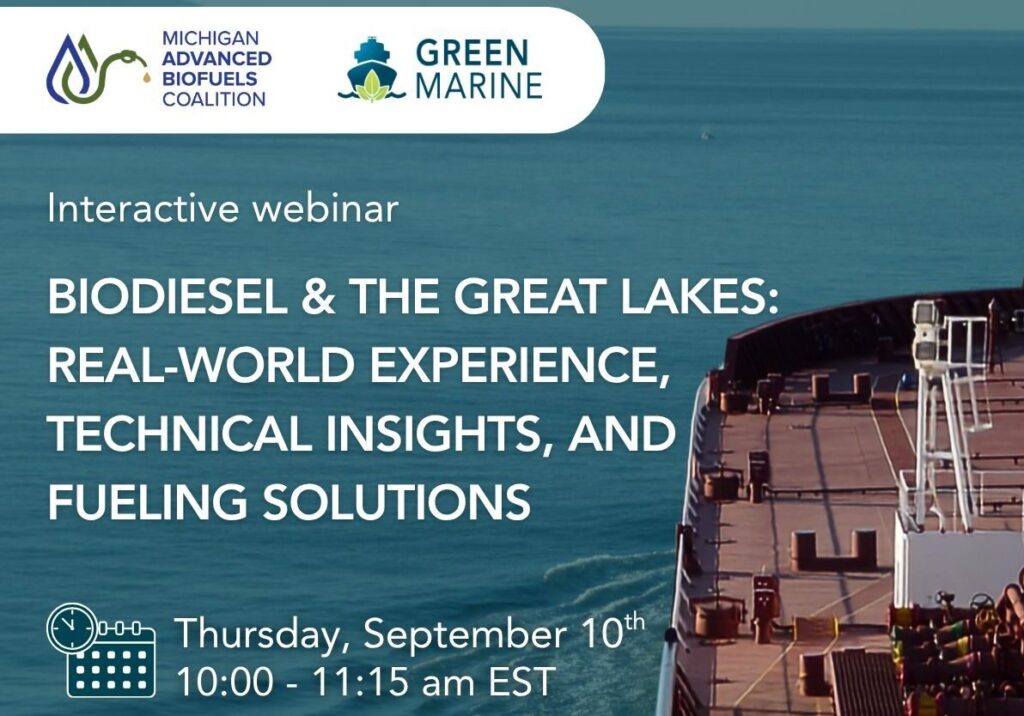
As interest in renewable marine fuels continues to grow, the Michigan Advanced Biofuels Coalition (MiABC), in partnership with Green Marine, will host an educational webinar on September 10 at 10:00 a.m. ET titled “Biodiesel & the Great Lakes: Real-World Experience, Technical Insights, and Fueling Solutions.”
The webinar will bring together vessel operators, biodiesel marketers, marine fuel suppliers, and industry experts to discuss firsthand experiences deploying biodiesel across the Great Lakes. Attendees will gain practical insights into fuel quality, engine compatibility, operational performance, fueling logistics, and lessons learned from commercial marine applications.
Featured discussions will include real-world perspectives from Great Lakes vessel operators—including Canada Steamship Lines (CSL)—along with technical presentations from fuel suppliers and renewable fuel experts. A live question-and-answer session will provide participants with an opportunity to engage directly with the speakers and explore the opportunities and challenges associated with expanding biodiesel use throughout the region.
Whether you are a vessel owner, port operator, marine engineer, fuel supplier, policymaker, or simply interested in the future of sustainable shipping, this webinar offers a timely opportunity to learn how renewable biofuels are helping shape the next generation of Great Lakes maritime transportation.